
Marketing Funnel is the model that explains how strangers become customers and advocates. It translates messy journeys into clear, staged decisions you can influence. It turns budgets into measurable pipeline and revenue. It also anchors cross‑team plans, including how ProEdge blends media, content, and sales enablement for sustainable growth.
What a marketing funnel means today
The classic view shows a wide top and a narrow bottom. Modern journeys loop, stall, and restart across channels and devices. A practical Marketing Funnel adapts to that reality while keeping everyone focused on the few moments that truly move revenue.

Defining the funnel in plain terms
A funnel is a staged map of intention, from first awareness to repeat purchase and advocacy. It gives teams a shared language for priorities, budgets, and metrics. A strong Marketing Funnel turns noise into signals, so each asset has a job and every touch has a next step. That clarity reduces waste and compounds results across quarters.
From AIDA to modern, looping journeys
Old models like AIDA assume clean handoffs. Real buyers research, compare, and return to search after demos. The Marketing Funnel must reflect loops, not lines, with content and ads ready for re‑entry. When stages anticipate detours, nurture flows catch drop‑offs and re‑qualify interest without pressure, improving conversion quality and long‑term customer value.
B2B, B2C, and hybrid funnel nuances
B2B funnels include committees, longer cycles, and enablement content. B2C funnels compress fast, yet retention and advocacy matter more than ever. Many firms sell to both buyers and users. The Marketing Funnel balances these paths by segment, building distinct triggers, proof points, and KPIs, so signals from one audience do not mask performance in another.
Why full‑funnel beats channel‑only plans
Channel strategies win clicks, but full‑funnel strategies win growth. The Marketing Funnel aligns brand, demand, and lifecycle, so messages compound rather than collide. Top‑funnel awareness lifts mid‑funnel engagement, which lowers cost per acquisition at the bottom. Retention then raises lifetime value, funding more reach. That flywheel makes budgets resilient through seasonality and shocks.
Funnel math and the leaky bucket
Every stage has a conversion rate that multiplies downstream results. Small lifts at weak links unlock big gains. Audit the Marketing Funnel for leaks, like low product page engagement or slow sales follow‑up. Fix them before buying more traffic. This habit protects CAC, stabilizes forecasts, and keeps growth ethical by matching promises with product reality.
From awareness to loyalty: stages that matter
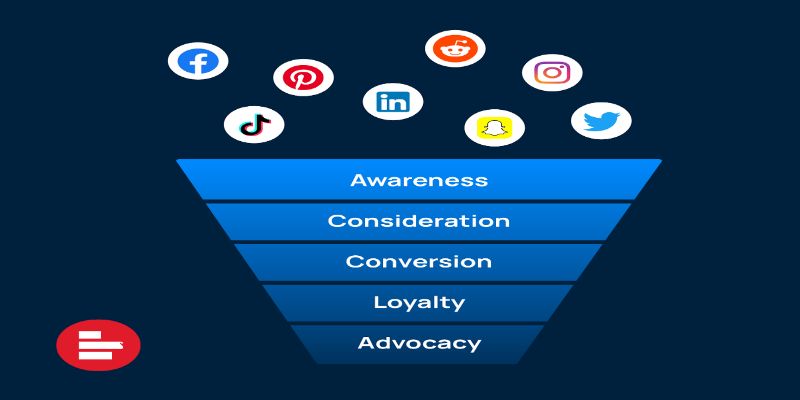
Stages focus teams on buyer progress, not vanity clicks. Use them to assign content, offers, and SLAs. A Marketing Funnel with crisp stage definitions turns qualitative intent into quantitative actions you can measure and scale.
Awareness: problem framing and category entry
Awareness earns attention with problems buyers actually feel. Lead with insight, not features. The Marketing Funnel at this stage favors reach formats, distinct points of view, and category language. Use search trends, social listening, and competitor gaps to craft themes. Success looks like qualified attention, rising branded search, and engaged visits that progress to deeper content.
Consideration: education and evaluation
Consideration content answers how, why, and what‑if. Comparison pages, calculators, and case studies build trust without pushiness. The Marketing Funnel here emphasizes proof and clarity, guiding buyers to shortlist you by merit. Capture intent with soft gates and firm privacy standards. Sales should receive only accounts that meet fit signals, avoiding fatigue from premature outreach.
Conversion: frictionless decisions and offers
Conversion design removes extra steps and doubts. Social proof, transparent pricing, and fast pages close gaps. The Marketing Funnel succeeds when copy matches prior promises and forms request only necessary data. Use warm retargeting, intent‑based email, and conversational demos. Monitor drop‑off by field, step, and device, then test fixes before scaling traffic to protect CAC.
Retention: onboarding, value realization, and habit
Retention begins at handoff. Onboarding should prove value in days, not months. The Marketing Funnel continues post‑purchase with lifecycle emails, in‑product tips, and quick‑win milestones. Measure activation, feature adoption, and expansion triggers. Effective support and community reduce churn. Loyalty grows when customers feel progress, not pressure, which keeps referrals authentic and reviews specific.
Advocacy: social proof and community effects
Advocates amplify credibility beyond paid reach. Turn stories into case studies, quotes, and category education. The Marketing Funnel re‑invests advocacy back into awareness with creator partnerships and user groups. Build programs that reward teaching, not only discounts. Track share of voice, review volume, and referral velocity to ensure advocacy remains genuine and helpful for new buyers.
Data, tools, and alignment for scalable growth
Great strategies fail without clean data, shared systems, and fast feedback. The Marketing Funnel needs instrumentation, not assumptions. Consistent definitions and dashboards let teams act weekly, not yearly, so budgets move toward what compounds real revenue.
CRM and automation as the system of record
Reliable CRM fields and lifecycle rules prevent stage chaos. Marketing automation must enrich, route, and nurture with context. The Marketing Funnel relies on timestamps, sources, and engagement scores to guide handoffs. Document SLAs and exceptions. Audit duplicate leads and stale accounts. When systems reflect reality, forecasts tighten and experiments teach faster with less spend.
Content mapping and atomic assets
Map every asset to a stage, persona, and job to be done. Create atomic components you can remix across ads, email, and sales decks. The Marketing Funnel accelerates when stories flow consistently across channels. Maintain a content ledger with ownership, performance, and refresh dates to prevent decay and keep proof points current.
Media mix and attribution without the myths
Over‑crediting last click starves awareness. First‑touch bias overvalues splash. The Marketing Funnel needs triangulation: experiments, correlations, and incrementality tests. Use modeled attribution as a guide, not a verdict. Combine platform data with server‑side events and surveys. Partners integrate these signals to tune the mix without chasing vanity metrics.
Sales alignment and enablement that wins time
Speed‑to‑lead, context, and proof beat raw volume. Share buyer insights from the Marketing Funnel at weekly standups. Enable reps with concise one‑pagers, objection libraries, and tailored case studies. Record outcomes and reasons. Close the loop into targeting and creative. When marketing equips real conversations, pipelines improve quality and deals move with fewer meetings.
Conclusion
Marketing Funnel turns scattered tactics into a shared, revenue‑first roadmap. It clarifies where to invest, what to fix, and how to pace scale. It keeps promises aligned from ad to onboarding, so growth feels earned. It is also how ProEdge helps teams turn insights into outcomes across quarters.